
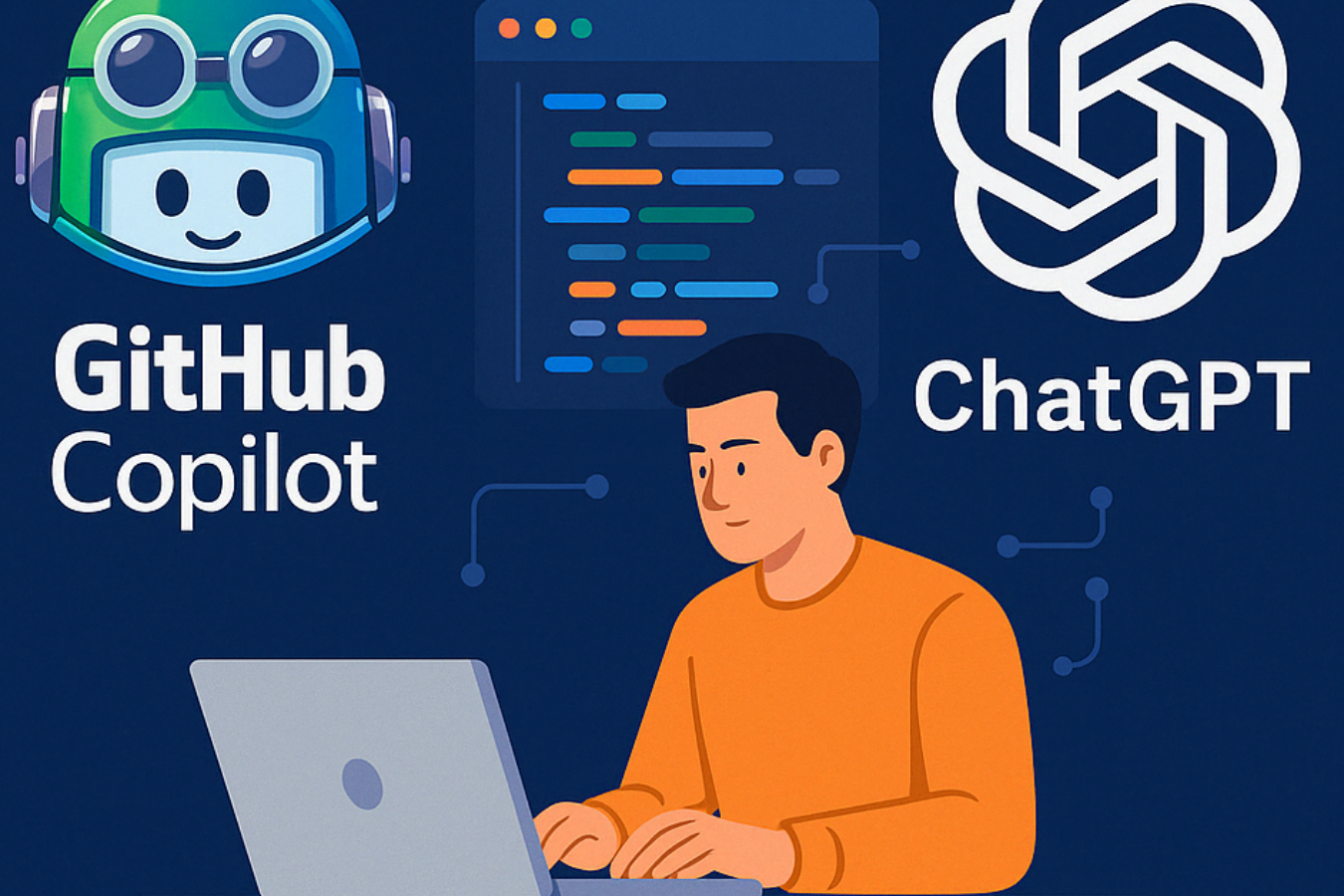
Artificial Intelligence (AI) has become an integral part of the technological world, with its application in software development revolutionizing the way programmers work. Tools like GitHub Copilot and ChatGPT are no longer experimental technologies but real aids in developers' daily tasks. They automate routine processes, accelerate code creation, and enhance its quality.
GitHub Copilot is an AI-based assistant jointly developed by GitHub and OpenAI. It uses large language models to predict what code the user might write, offering entire lines or functions. It works with popular programming languages such as Python, JavaScript, C#, Go, and more. Copilot integrates with code editors like Visual Studio Code and provides features such as autocomplete, function suggestions, and documentation.
ChatGPT from OpenAI, on the other hand, is a language model that understands and generates text in natural language. It can be used to generate code, explain complex programming concepts, debug errors, create tests, and even provide suggestions during application architecture planning. Unlike Copilot, which operates mainly within IDEs, ChatGPT can also be used as an external consultant, accessible via browser or API.
AI tools are useful across all stages of the software cycle—from planning and writing code to testing, validation, support, and documentation. They help generate architectural drafts, automatic tests, documentation, and facilitate understanding of foreign code. These tools are indispensable not only for beginners but also for experienced developers.
The benefits of using these AI tools are numerous. First and foremost, productivity significantly increases. Instead of wasting time looking up syntax or referring to documentation, developers can rely on intelligent suggestions. Furthermore, code quality improves through automatic checking and optimization suggestions. For beginner programmers, AI offers a learning-friendly environment with instant feedback.
However, there are some challenges. One of the main issues is that AI tools don't always fully understand the context of a project and may offer solutions that are inefficient or even incorrect. There are also concerns related to copyright, as the generated code might resemble existing licensed code. Excessive reliance on these tools may lead to skill degradation for developers. Finally, there are open questions regarding data security and confidentiality when sending code to external servers.
Despite this, the real-world use of AI in development is already a reality. Integrations like Stack Overflow AI, Microsoft Copilot in Office packages, and tools like Codeium and Tabnine show that the market is actively evolving. In the near future, AI is expected to become even more deeply integrated into development environments, with specialized agents for specific technologies and better understanding of business logic by AI.
In conclusion, GitHub Copilot and ChatGPT are just the beginning of a new era in programming. They are not merely support tools, but intelligent partners in the workflow. Developers who embrace and adapt to them will be leading figures in the industry's evolution. The integration of AI does not signify the end of the human role, but rather its expansion—a collaborative effort between human and machine to achieve better, higher-quality, and faster software.